




Following recent publications about a projected depletion of oil in Liza phases 1 & 2 in another three years, many Guyanese, including prominent politicians, seem to have gotten lost in an idea that this projection, if accurate, leaves Guyana stranded; as the nation would be left a “developing country” even as its most marketable resource is gone.
TikTokers have used a Kaieteur News article to highlight this perceived pickle (https://vt.tiktok.com/ZS5wP83mE/). The comments left by many Guyanese indicate a worry that the nation’s oil will soon be gone while many Guyanese are no better off.
Further, some politicians, including Members of Parliament, have shared the article, adding to the growing concern.
This piece is not intended to address the concerns about benefits to the people, but seeks to clarify Guyana’s position as an oil producer.
LIFE AS AN OIL PRODUCER
ExxonMobil’s sequence of oil and gas developments off the coast of Guyana is structured to sustain production well into the 2030s. Such development is underpinned by long-life project licenses and a pipeline of new features that progressively add capacity as older projects mature.
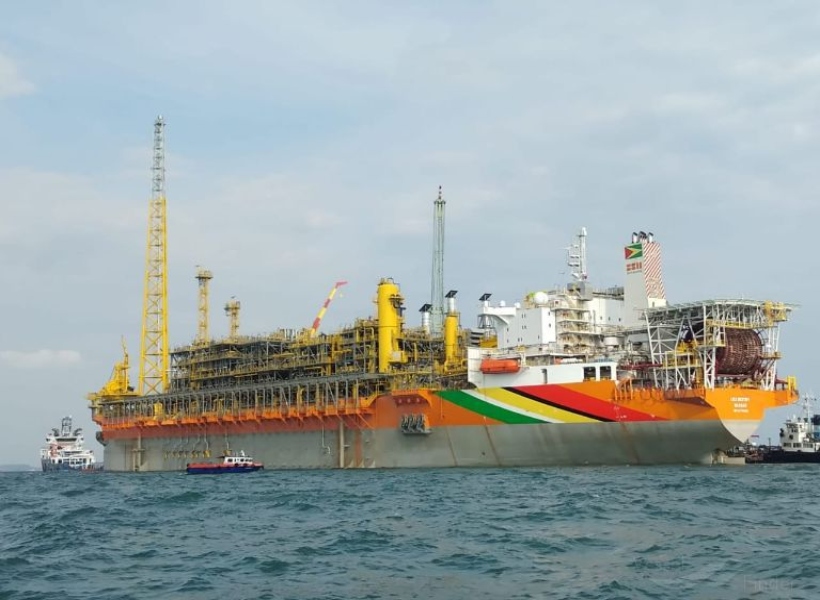
The U.S. major and its co-venturers Chevron (which recently acquired Hess) and CNOOC have identified eight offshore projects in the Stabroek Block, seven of which have already received government approval. Four projects, namely Liza 1, Liza 2, Payara and Yellowtail, are currently producing oil, with combined installed capacity exceeding 900,000 barrels per day (bpd).
Production capacity is set to rise sharply over the next several years as new projects come online. Uaru, the fifth development, is scheduled to begin production this year, followed by Whiptail in 2027. Each project is designed to add about 250,000 bpd of oil production capacity, lifting total installed capacity to more than 1.4 million bpd by 2028.
Hammerhead, expected to start production in 2029, will add both oil and gas output. The project is designed to produce up to 150,000 bpd of crude oil and around 90 million cubic feet per day of natural gas. Unlike earlier developments where produced gas is largely reinjected to maintain reservoir pressure and support oil recovery, Hammerhead’s gas is expected to flow directly into a new offshore-to-onshore pipeline as soon as the project starts up.
That pipeline, installed by ExxonMobil, is central to Guyana’s Gas-to-Energy project. The Liza field (covering the first two projects) is expected to begin supplying about 50 million cubic feet of gas per day into the system once the onshore Gas-to-Energy project infrastructure is completed this year, based on the government’s projection. Hammerhead will boost gas supply through the pipeline, supporting domestic power generation and the production of natural gas liquids for export. This will provide another stream of revenue for Guyana beyond oil sales and royalties.
Beyond Hammerhead, ExxonMobil has proposed an eighth project, Longtail, which remains under review and is likely to be approved this year. Longtail would be the first development offshore Guyana, targeting a gas-dominant field rather than oil. The project is designed for a 30-year lifespan and would produce both natural gas and condensate, a light hydrocarbon liquid commonly found in gas fields. ExxonMobil has said Longtail could produce up to one billion cubic feet of gas per day at peak, with output ramping up gradually over several years, alongside condensate production of up to 250,000 bpd.
Individual projects move through several phases. They first ramp-up for months to their production capacity, then are sustained at that capacity, called the plateau, for several years. Following this plateau, as more oil is taken out and the pressure in the underground reservoirs decline, the oil is produced at a slower rate. This results in the decline phase of oil production, which takes many years.
LIZA’S YEARS
There is a misconception in the public that one can take the current production rate of oil and use that to predict when the oil field will dry up. But the rate of production is not to be maintained until the oil is depleted. So this method of projection is flawed. Liza 1, for example, ramped up to its design rate of 120,000 bpd, was later optimized to produce at up to 160,000 bpd, then began a slow decline to the more recent 130,000 bpd range. This project is expected to take years to decline, but that period cannot be calculated using the current rate of production. The reality is way more dynamic.
Even as each project goes through these stages, the staggered commissioning of new developments is designed to add production in new fields, while the maturing fields decline. An oil company can also decide to tie in separate oil discoveries to existing infrastructure, allowing the project’s production to increase once more and even extend its life cycle.
Each oil project is licensed to produce for 20 years, while the Longtail project is expected to be licensed for 30 years of production. The overlapping timelines for each oil and gas project means that production of hydrocarbons will be sustained for many years, providing a lasting stream of significant revenue for Guyana and the oil companies.