





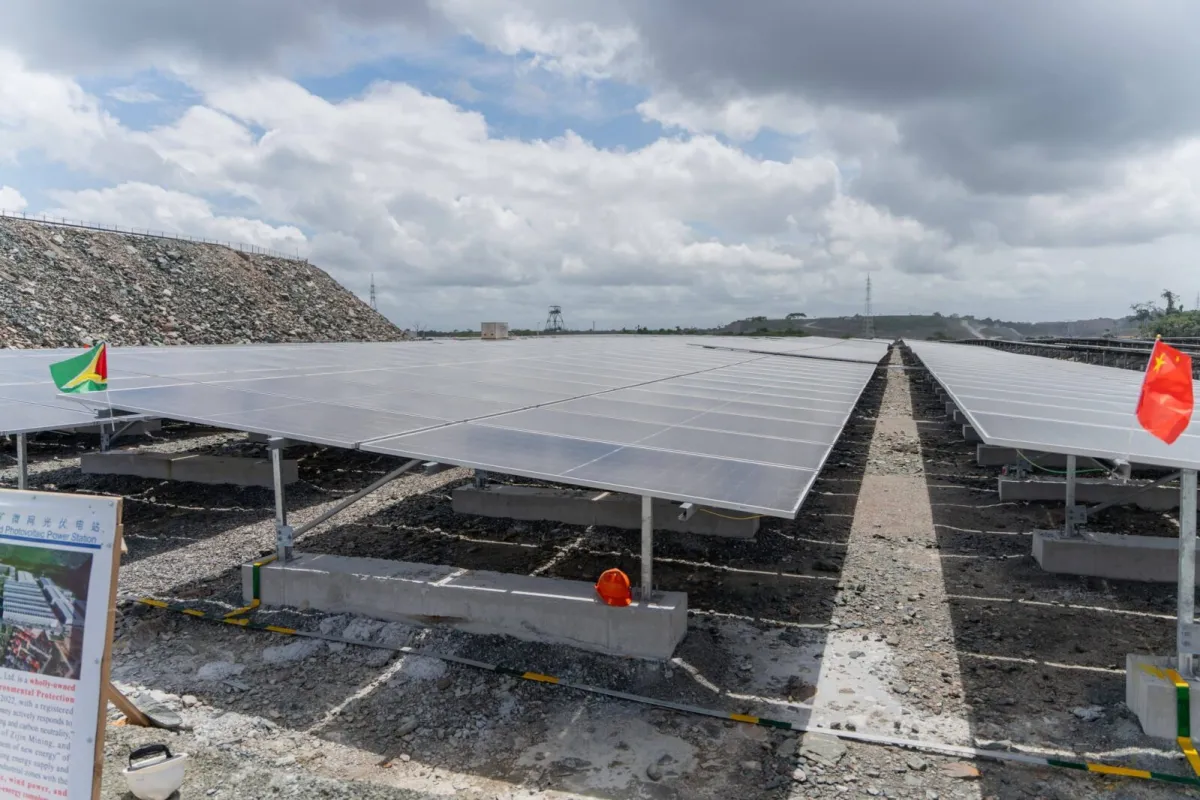
The prime minister on Thursday described the project as a landmark investment that will significantly reduce reliance on diesel while supporting the government’s national push towards renewable energy.
He revealed that the facility is expected to cut approximately 46,000 tonnes of carbon dioxide annually, and reduce harmful emissions such as sulphur and nitrogen oxides.
“This level of generation reduces reliance on diesel fuel and results in significant emissions reductions,” the prime minister stated.

The solar farm is one of the largest in Guyana. It features an advanced system that integrates power generation and battery storage in real time, ensuring a stable and reliable electricity supply.
Its commissioning marks a transformation for the Aurora Gold Mine, which previously depended entirely on diesel-generated power.
The project created approximately 100 local jobs during its construction, providing Guyanese workers with hands-on training in renewable energy systems, battery storage, and microgrid management.
“These are skills that will remain relevant as Guyana continues to expand its use of renewable energy,” Prime Minister Phillips emphasised.

He noted that the initiative aligns with Guyana’s Low Carbon Development Strategy 2030, demonstrating how clean energy solutions can be successfully integrated into industrial operations, even in hinterland and remote locations.
The prime minister also pointed to the commissioning of a solar facility at Charity earlier this year under the Guyana Utility Scale Solar Photovoltaic Programme, which forms part of a broader effort to expand solar energy across multiple regions.
“These investments are complemented by grid upgrades, battery storage, and additional energy projects aimed at reducing costs and improving reliability across the country,” he added. (Department of Public Information)