



The expansion of the Low Earth Orbit (LEO) WiFiGY, a visionary national connectivity programme spearheaded by the Prime Minister, Brigadier (Ret’d) Mark Phillips, has achieved a historic milestone.
Translated into real terms, it means that every hinterland, remote, and riverain community can now enjoy uninterrupted high-speed internet access for the first time in the nation’s history.

The rollout now spans all 253 Indigenous villages, benefitting over 135,000 residents, a remarkable feat that will positively impact families who will save on the cost of purchasing data and children who can now complete their schoolwork promptly. Educators, too, will have access to online training programmes that were once out of reach.
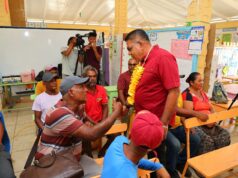
“This will bring a lot of ease for parents who usually spend large sums on mobile data for their children’s research. With WiFi now at the community centre, children can come here and get their homework done,” Michelle Drepaul, Vice Chairperson of the Lamaha/Yarrowkabra Council, said.
Prime Minister Phillips emphasised that WiFiGY is not only about connecting villages to the internet, but about closing historic gaps between coastal and hinterland Guyana.
“With the completion of this programme, every Indigenous community is connected. Every child, family, and entrepreneur now has a pathway to digital opportunities that were once out of reach. This is how we build equity, strengthen national participation, and continue moving Guyana forward”, Prime Minister Phillips said.
In rural households where mobile data expenses often compete with groceries or transportation, the new WiFi service will ease long-standing financial pressures.

In South Rupununi, Aishalton Village Toshao Michael Thomas stated that the new system is the community’s first stable, scalable internet solution.
The village previously relied on limited mobile data from a private provider, but it would collapse when more than 15 people logged on simultaneously.
“We were paying for a service that didn’t meet the needs of the village,” Thomas told the Department of Public Information (DPI).
This caused major setbacks, especially for students enrolled in the Guyana Online Academy of Learning (GOAL) and trainee teachers at Cyril Potter College of Education (CPCE) who were unable to connect remotely for classes.
Prime Minister Phillips highlighted the programme’s tailored approach to solar-powered, pole-mounted systems, which are built to withstand remote terrain, ensuring uninterrupted 24/7 access for the villages that need it the most.

Now that the LEO WiFiGY system is set up at the village office and planned for the future ICT hub, Aishalton has a clear path ahead.
“This will be a big move for Aishalton in terms of attaining internet access. Priority will be given to those using the internet for education…submitting assignments and so forth,” Toshao Thomas noted.
“We had considered installing the internet before, but the cost was too high. Now that NDMA has provided this service, it will benefit us greatly. We give a big thank you to the Government of Guyana”, he said.
With WiFiGY, community learning centres, schools, and dorms now report that students are completing assignments faster, and more children are enrolling in GOAL-supported digital-skills programmes. (Department of Public Information)