



“No one is above the law”. It sounds good. It travels well. But too often, it is enforced selectively; loudly against some but quietly ignored for others.
That is why Vice-President Bharrat Jagdeo’s public warning to Police Commissioner Clifton Hicken was found unsettling by many.
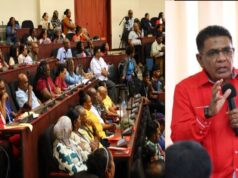
Jagdeo was not speaking in general terms. He was referring to Azruddin Mohamed’s Lamborghini. This is the very vehicle at the centre of accusations that its value was deliberately understated to evade millions of dollars in taxes. It is also the same Lamborghini Mohamed drove to Parliament in what many saw as a calculated show of defiance, a public “flex” aimed squarely at Jagdeo and the political establishment.
Against that backdrop, Jagdeo issued a pointed warning. He declared, “I would hold Hicken, the Commissioner of Police, personally responsible if a child or anyone gets hit down on the road and gets killed or maimed by that Lamborghini when it’s on the road.”
Those words matter. They did not target the owner. They did not target the driver. They placed responsibility directly on the Police Commissioner.
For years before the fallout, there was no such warnings coming from the PPP regarding any of the operations of the Mohameds; vehicle related or otherwise. There were no urgent interventions, no public clampdowns, and no talk of holding the Commissioner personally responsible. That silence is now impossible to ignore.
Only after relations soured did enforcement suddenly find its urgency.
Shortly after Jagdeo’s statement, police action followed, first involving the Lamborghini, then expanding to other vehicles linked to Mohamed’s family. As recent as Christmas Day, police ranks stopped a Toyota Land Cruiser linked to Mohamed’s family on the Eccles Public Road.
The details of that stop are now public. The vehicle was pulled over. Documents were requested. Mohamed arrived and told the driver (his sister) to leave. Police followed. The vehicle was detained. Charges are pending. On paper, that looks like good, solid police work.
But Guyanese are not naive. We understand that law enforcement is judged not only by legality, but by timing and consistency.
The uncomfortable truth is that this sequence leaves only two explanations. Either the police had reason to act long before and chose not to, or action came only because a public political signal was sent. One suggests negligence. The other suggests political pressure. Neither supports the idea of an independent and strong police force.
What makes this situation especially dangerous is what Jagdeo’s statement has done to Commissioner Hicken.
By declaring that the Commissioner would be responsible if “anything happens” involving a specific vehicle, Jagdeo has dragged the office of the Police Commissioner into a space it has never occupied before. He has opened the door to potential legal claims and, just as importantly, public anger from families who have already paid the highest price on Guyana’s roads.
Every year, people die in accidents involving uninsured, improperly documented, or unroadworthy vehicles. Families grieve quietly. Justice moves slowly. In none of those cases has any government official suggested that the Commissioner of Police bears personal responsibility for those deaths.
So why now?
What is being said to the parents who buried children killed by illegal vehicles last year? Or the spouses who lost partners before this political feud erupted? Are they to believe that accountability depends on the profile of the vehicle owner or the timing of a fallout?
This is the danger of selective accountability. Once responsibility is personalised in one high-profile case, it exposes the absence of that same urgency everywhere else.
In the escalating rivalry between the Government and a man who was once a trusted financier, Commissioner Hicken has become collateral damage. The warning issued by Jagdeo did not strengthen law enforcement; it weakened it by tying the Commissioner’s professional standing to a political dispute.
If the Lamborghini was illegal, it should have been dealt with long before it became a symbol of defiance. If it was legal, then threatening personal responsibility against the Commissioner was reckless. Either way, the law was never supposed to work like this.
The public does not need political theatre. It needs consistency. It needs to know that enforcement does not switch on only after a “flex” in Parliament or a public warning from a Vice-President.
Because when enforcement appears reactive and selective, trust collapses. And when trust collapses, even lawful actions begin to feel suspect.
The rule of law cannot survive on slogans alone. It survives on fairness, restraint, and independence. Without those, “no one is above the law” becomes just another line that is said loudly, enforced unevenly, and believed by fewer each day.