






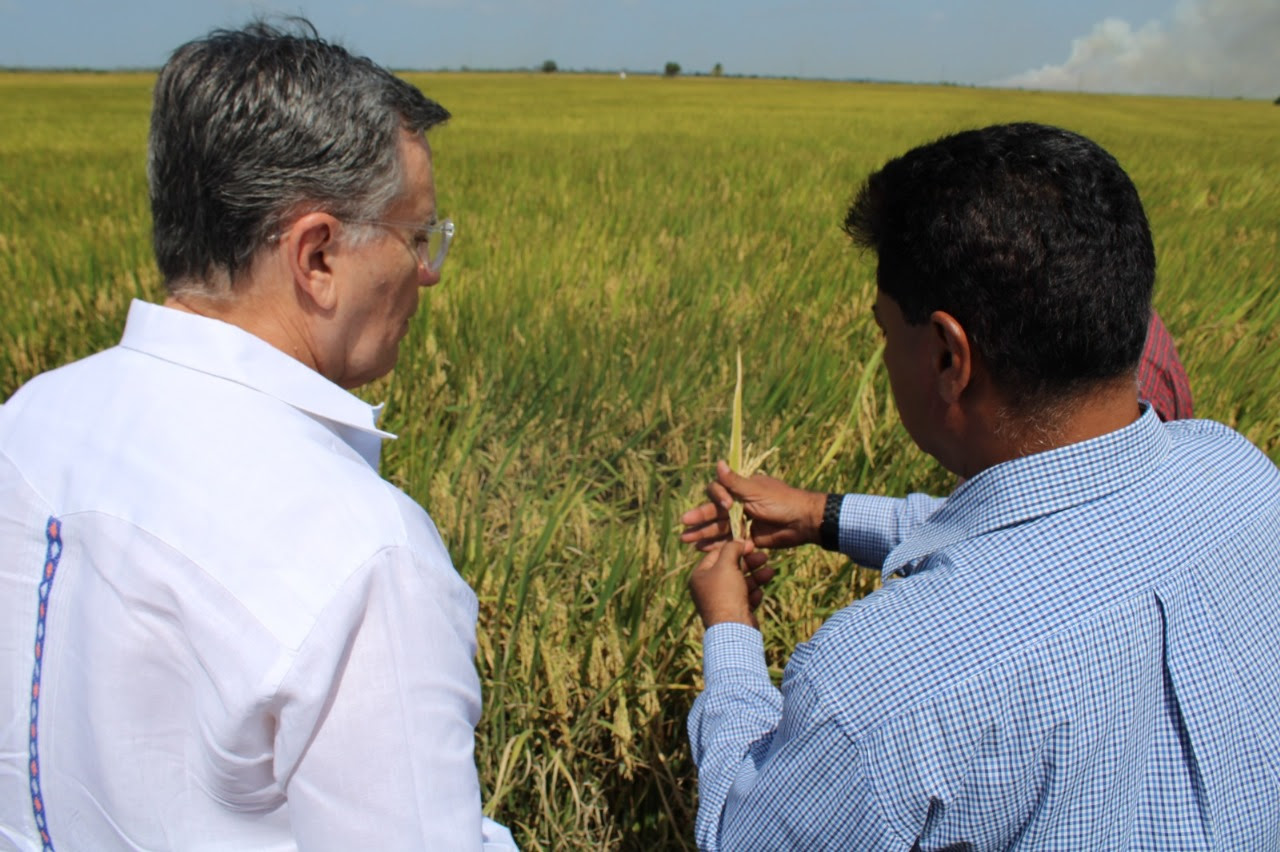
Speaking to the Department of Public Information (DPI) at the Burma Rice Research Station, GRDB Agronomist and Head of Department, Dr Ghansham Payman, said the technology has consistently produced healthier rice plants and comparable or improved grain quality during research evaluations.

“The yields are identical, and in some cases as much as an eight to 10 per cent increase in grain yield,” Dr Payman stated.
He explained that because the Nano Urea is rapidly absorbed through the leaves, rice plants remain greener for longer, exhibit improved plant vigour and produce healthier grains.
The findings are based on extensive evaluations conducted over three consecutive cropping seasons when the technology was adopted through a collaboration between the Ministry of Agriculture and the GRDB.
Dr Payman noted that the improved nitrogen efficiency use of the Nano Urea enables the crop to utilise more of the applied nutrients compared with conventional urea, resulting in stronger crop performance while reducing environmental losses.

The Nano Urea is a liquid fertiliser containing very small nitrogen particles (nanoparticles) that help plants absorb nutrients more efficiently.
It is used as a supplement or partial replacement for conventional urea to improve crop growth, reduce fertiliser wastage and lower environmental pollution.
The research forms part of the government’s wider efforts to modernise rice cultivation by introducing climate-smart technologies that improve productivity, lower production costs and strengthen the competitiveness of Guyana’s rice industry. (Department of Public Information)