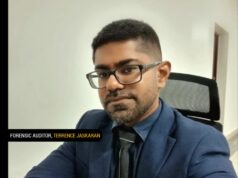
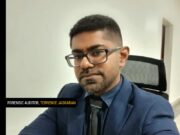





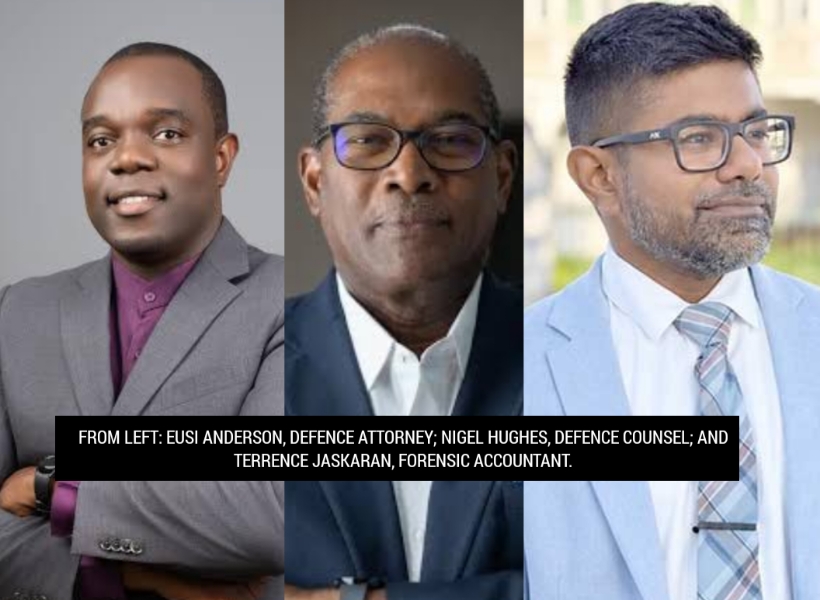
Forensic accountant Terrence Jaskaran today admitted under cross-examination that he destroyed contemporaneous notes containing instructions he received from police during his audit of the 2020 elections. He did this despite knowing that he had already prepared his report and was likely to be called as a witness in the election fraud case.
Jaskaran was continuing his testimony before Principal Magistrate Faith McGusty at the Georgetown Magistrates’ Court when defence attorney Eusi Anderson questioned him about notes he said he had made in his personal diary while receiving oral instructions from Inspector Nigel Stephens.
Jaskaran said he usually disposes of his personal diaries after three to four years and eventually shredded the diary containing notes from the election audit.
When Anderson pressed him to say whether he had destroyed the record of the notes, Jaskaran responded: “Those notes in my diary were destroyed by me.”
He further confirmed that he knew, at the time he shredded them, that his report and statement in the proceedings had already been prepared and that he was expected to be a witness.
Jaskaran said the notes contained three basic points, including instructions to “certify copies of SOPs,” compare them with Form 24 declarations and provide a report.
Anderson questioned whether the destroyed notes could be recovered, but Jaskaran said they had been shredded approximately three to four years after they were made.
The defence also challenged the foundation of Jaskaran’s expert evidence, including his training and experience. Jaskaran is an accountant and forensic auditor, but the defence has previously pointed to the absence of demonstrated specialised training or experience in auditing elections and electoral results.
The issue of his expertise was also revisited by defense counsel Nigel Hughes, who obtained permission from the court to reopen his cross-examination after raising concerns about potential bias.
Hughes confronted Jaskaran with a series of Facebook posts published in August 2025 in which he expressed strong views about the APNU/PNC and the 2020 elections.
Jaskaran accepted that the posts were his and that they reflected his views at the time.
Among the statements read to him was his assertion that the voting in the 2020 elections was fair, but that what followed during the tabulation stage was “nothing short of the PNC of old.”
He also accepted writing that the APNU/PNC had sought to return to “the ways of rigging for victory” and that suggestions that the party had not attempted to “steal” the 2020 elections were “laughable.”
Hughes argued that the posts demonstrated that Jaskaran had already formed strong views about the party before entering the witness box as an expert.
Jaskaran maintained that the posts represented his views on the events at the time and rejected Hughes’ description of those views as hostility.
He acknowledged, however, that he knew there was a possibility he would be called as an expert when he made the posts and admitted that he had not informed the prosecution or the court about them before testifying.
At the end of the questioning, Hughes told the court he would submit written arguments seeking a review of Jaskaran’s status as an expert, saying the issue was of “significant import.”
The question of how much weight should ultimately be attached to Jaskaran’s opinion also remains for the court. Magistrate McGusty had previously made clear when she accepted him as an expert that that designation did not mean his opinion would automatically be accepted; the court would still have to assess the weight to be attached to his evidence.
The defence’s cross-examination also highlighted limitations surrounding the source material Jaskaran used. He acknowledged that some SOPs were missing or blank and that he did not obtain substitute copies from GECOM or the relevant administrative authorities.
He also agreed that if additional SOPs containing relevant figures were produced, his calculations could have to be adjusted.
Jaskaran nevertheless maintained that his report was conclusive in respect of the data that had been provided to him and said the missing or blank SOPs had been identified in his report.