




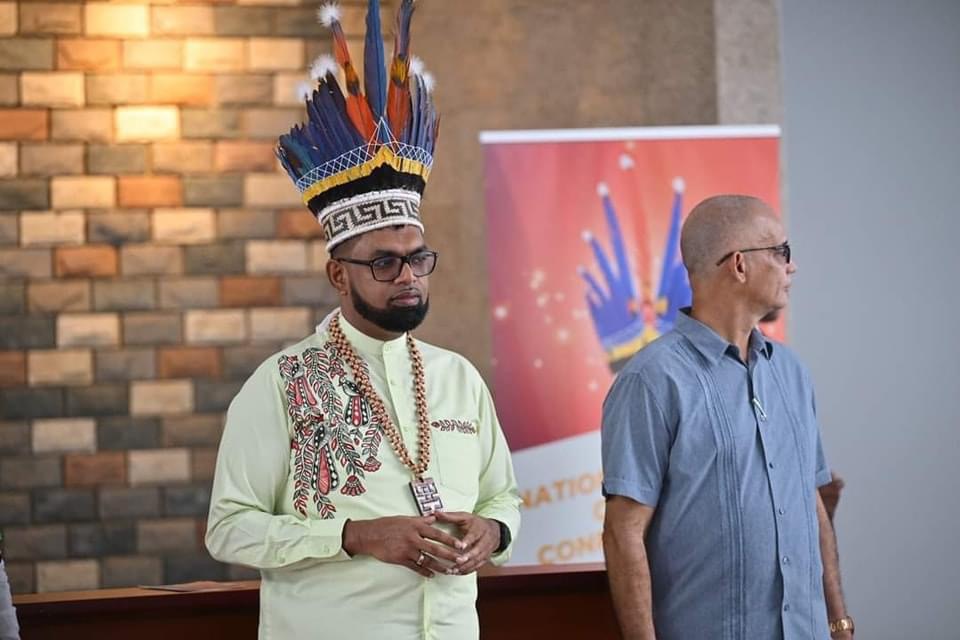
President, Dr. Mohamed Irfaan Ali on Monday highlighted the notable strides made by successive PPP/C governments in uplifting indigenous communities. He also underscored that the National Toshaos Council (NTC) Conference provides a valuable opportunity to reflect on these achievements while charting the way forward.
Speaking at the National Toshaos Council (NTC) Conference 2024, President Ali stressed the importance of anchoring Guyana’s future in its rich cultural heritage, asserting that the nation’s progress must always be rooted in its traditions and identity. “For us, your future must be anchored in heritage. Let us never forget that the future we build must be rooted in our heritage,” he stated, emphasizing that heritage is more than just a part of identity—it is a source of strength, pride, and the foundation upon which a prosperous future can be built.
President Ali outlined his intention to examine key periods in Guyana’s history to understand the development of policies, evolved governance structures, and the pursuit of truth. He underscored the government’s commitment to democracy and open dialogue, stressing that under his leadership, “every entity must have the opportunity to speak freely, democratically, and openly.” He added, “This is a core principle and belief of the People’s Progressive Party.”
However, the President did not shy away from calling out what he termed as hypocrisy in the political landscape. “If you’re political, you’re political. If you’re a political entity, you’re a political entity, but do not hide under the veil of NGOs and these things; that is hypocrisy,” he stated, emphasizing the need for transparency and integrity in all forms of leadership.
President Ali then delved into the historical context of his position, particularly focusing on the period before 1992—a time when democracy was restored in Guyana. He described the pre-1992 era as one of severe neglect, especially for the indigenous communities that were marginalized and excluded from the nation’s social and economic development. “Seven out of every ten households in the hinterland region were faced with absolute poverty,” he said, emphasizing the stark reality that indigenous people faced during this period.
He went on to detail the systemic exclusion of Amerindians from national policies under the previous PNC government. “Your affairs were handled by a department within the Ministry of Regional Development,” President Ali revealed, pointing out that this department was staffed by only one person, a stark indication of the lack of attention given to indigenous issues.
The President further highlighted the significant disparities in education, noting that before 1992, most villages in the hinterland had no access to formal education, primary schools, or trained teachers. He stressed that no scholarships were awarded in Regions 1, 7, 8, and 9, and that the secondary enrollment ratio in these regions was less than half the national average. “As a result, our Amerindian young people never had the opportunity of dreaming of a secondary education, let alone a university education,” he said.
Reflecting on the progress made since 1992, President Ali asserted that today, the situation has drastically improved. “Today, you’re not dreaming. You are achieving,” he declared, acknowledging the strides made by the indigenous communities in education and professional development. He then urged the younger generation to honor the older leaders who were left neglected and marginalized but still persevered. He assured that the current administration will continue to work earnestly to preserve the rich cultural heritage of indigenous communities while ensuring their development.