




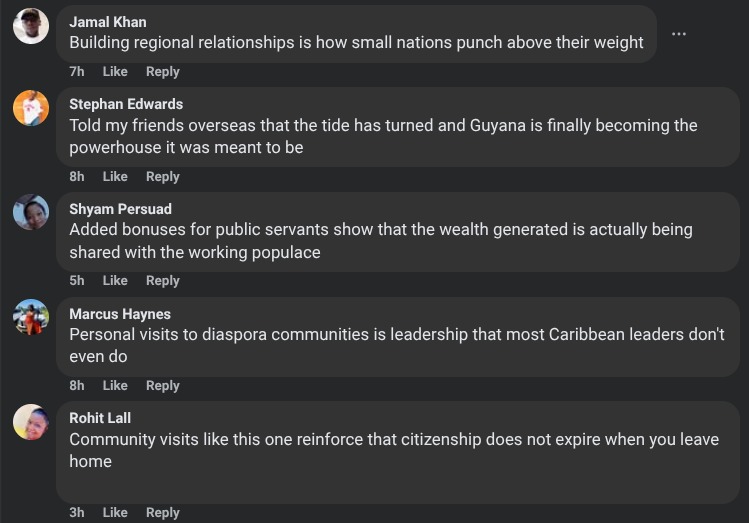
Several recent posts on the Facebook page ‘President Irfaan Ali’ have drawn hundreds of positive comments from accounts with little to no visible activity. The phenomenon is consistent with the recent rise in artificial intelligence (AI) bot comments being employed on social media sites like Facebook and X to shape public opinion.
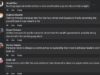
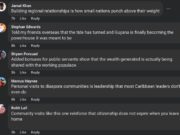
The comments, which appear beneath multiple recent posts by the President’s account, are exclusively supportive. They frequently commend the President, the government and the People’s Progressive Party for promoting unity, harmony and national development, often using broad, formulaic language.
Many of the accounts posting these messages display a single profile photograph and little to no other public content. There is typically no visible posting history, personal updates or interaction outside of the praise comments. They are labeled as ‘new accounts’. In numerous instances, the words in the comments are highly repetitive.
For example, on a February 26 post about the President’s meeting with his Suriname counterpart, a commenter is named Bernadine Pilgrim, but the profile shows an apparent AI-generated image of a man. The comment states “Understanding geopolitics means recognising that influence comes from unity and structured communication.”
Another comment on the same post from Poonam Lall states “Aligned diplomacy like this proves that CARICOM is not just ceremonial but practical and strategic.”
Both profiles have no post history and the writing style reflects the generic writing style of generative AI products. That particular post has over 300 comments and the overwhelming majority reflect the same repetitive style from ‘empty’ accounts.
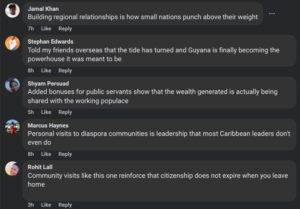
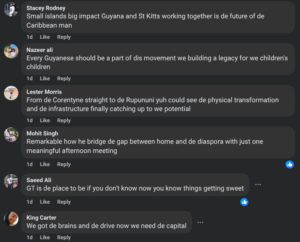
Some of the comments are even beginning to use some creole language. A February 27 post of the President meeting the Guyanese community in St. Kitts and Nevis shows comments like “We got de brains and de drive now we need de capital” and “Remarkable how he bridge de gap between de home and de diaspora with just one meaningful afternoon meeting”.
Similar observations have been made on political news reports from some news agencies.
Guyana Standard also monitored recent posts from We Invest in Nationhood (WIN) and Team Mohamed’s, associated with Leader of the Opposition, Azruddin Mohamed. The new politician’s popularity online has not gone without suspicion of bot activity, but such patterns were not observed in recent posts on the two Facebook pages.
In January, The Guardian reported that Maria Ressa, the Nobel Peace Prize-winning free speech advocate, joined leading artificial intelligence and social science researchers from institutions including Berkeley, Harvard, Oxford, Cambridge and Yale in flagging what they described as a growing threat from hard-to-detect AI-driven “swarms” on social media.
According to that report, experts warned that political actors around the world could deploy large numbers of human-imitating AI agents capable of mimicking authentic social behaviour. These systems, they say, are designed to blend into online communities and potentially influence public opinion at scale.
The researchers cautioned that such tools could be used to manufacture the appearance of support and drown out dissenting voices. Because these accounts can be programmed to appear human, with profile photos, names and conversational responses, they are often difficult for ordinary users to distinguish from genuine users.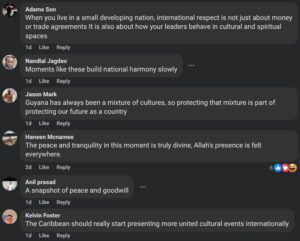
On President Ali’s page, the visible characteristics of the accounts posting the praise comments are consistent with the above-mentioned patterns commonly associated with automated or coordinated engagement.
There is no public evidence confirming whether the comments are generated by artificial intelligence or mass-coordinated by human operators. However, the concentration of similar praise from accounts lacking visible personal histories raises questions about their authenticity.