


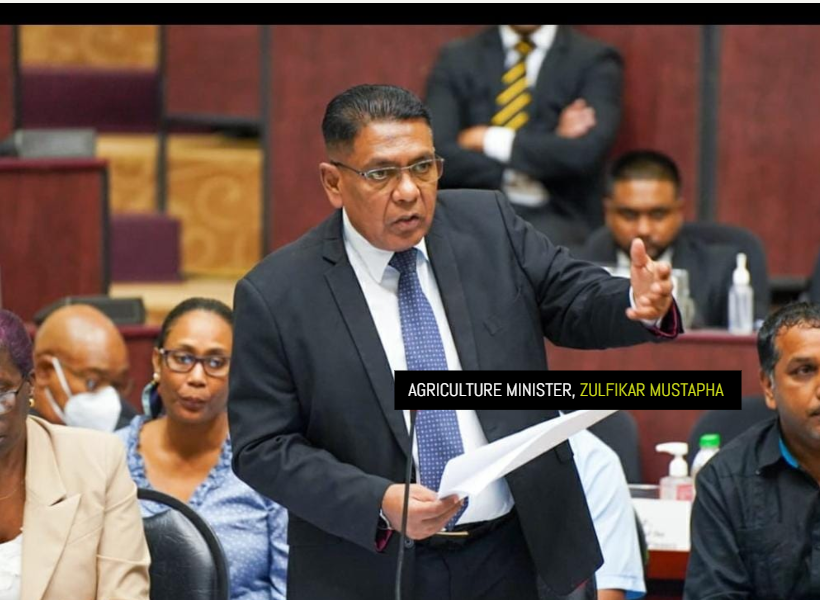



Guyana is advancing climate-resilient agriculture, innovation and inclusive policies to close the productivity gap in the region’s agricultural sector.
Minister of Agriculture Zulfikar Mustapha highlighted these efforts while addressing a ministerial roundtable on closing the productivity gap in Latin America and the Caribbean at the Food and Agriculture Organisation (FAO) regional conference on Wednesday.
The minister said Guyana’s agricultural transformation is closely aligned with the country’s Low Carbon Development Strategy, ensuring that sectoral growth remains climate-resilient, environmentally responsible and socially inclusive.
“Closing the productivity gap requires a holistic approach. Innovation, risk management, climate resilience and inclusion must go hand-in-hand,” he stated.
Minister Mustapha noted that Guyana has implemented several initiatives to strengthen agricultural productivity and resilience. Among these is the Premium-Free Crop Insurance Programme launched in 2025, which provides full coverage for losses caused by floods or drought. More than 4,200 rice farmers have already enrolled.

The government has also invested heavily in drainage and irrigation systems, farm-to-market roads and weather stations to improve resilience to hydrometeorological hazards.
Additionally, the National Flood Early Warning System has enhanced forecasting to safeguard households and agricultural assets.
Science and innovation also play a central role in the country’s agricultural strategy.
A state-of-the-art agricultural laboratory commissioned at the National Agricultural Research and Extension Institute (NAREI), in partnership with TERI India, will significantly expand the production of high-quality disease-free planting materials from 13,000 to one million annually across key crops.
Other initiatives include integrated rice production systems that combine rice cultivation with fish and duck rearing, as well as the adoption of precision agriculture, digital monitoring and nano-urea fertilisers to improve efficiency and input management.
The minister further highlighted Guyana’s efforts to ensure inclusion in the sector, noting that agricultural programmes target at least 35 per cent participation from youth and women.
More than 300 young people are engaged in the Agriculture Innovation and Entrepreneurship Programme, while over 700 shade houses have been constructed nationwide.
Efforts are also underway to expand women-led agri-processing initiatives and to support small farmers, youth and women through the proposed Guyana Development Bank, which will offer zero-interest, zero-collateral loans and mentorship support.
Minister Mustapha reaffirmed Guyana’s commitment to working with regional partners to build efficient, inclusive and sustainable agri-food systems across Latin America and the Caribbean.
The ministerial roundtable is taking place from March 4 to 6 in Brasilia, Brazil. (Department of Public Information)