






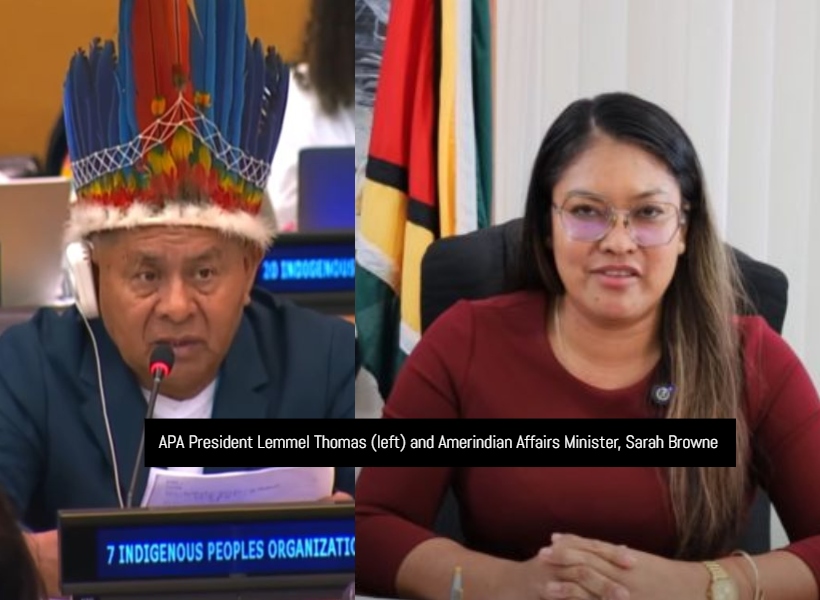
The Amerindian Peoples Association (APA) and the Government of Guyana presented conflicting accounts of Indigenous welfare before the UN Permanent Forum on Indigenous Issues (UNPFII) this week, as grassroots reports of “institutional discrimination” in healthcare collided with state claims of “unprecedented growth” through a $14.4 billion carbon credit investment.
While APA leadership detailed a crisis of mercury poisoning and cultural exclusion in the hinterlands, Government representatives touted a globally recognized model of climate partnership that has legally secured 16.4% of the nation’s landmass for Indigenous communities.
Representing the APA, the organization’s President Lemmel Thomas delivered a sobering intervention during the discussion on Indigenous health in the context of conflict and encroachment. The testimony painted a picture of a “generational” struggle where elders must trek through treacherous mountains and rivers to access basic care, and men face life-threatening snakebites without available anti-venom.
“Our health depends on the survival of our culture, the promotion of our knowledge systems, and the protection of our lands,” the APA President stated. The association specifically linked the “encroachment of mining” to a surge in malaria, dengue, and mercury poisoning, arguing that the destruction of natural medicines by the extractive sector is a dismissal of traditional culture.
The APA further highlighted a linguistic divide, noting that patients often suffer critical delays because healthcare providers cannot understand Indigenous languages. They called for an end to the “politicization” of community issues and urged the government to conduct consistent consultations that respect the self-determination of Village Councils.
In a separate interactive dialogue, Sarah Browne-Shadeek, Minister of Amerindian Affairs, presented a vastly different perspective on the state of the hinterland. Addressing the theme of climate change, the Minister framed Guyana as a global leader in Indigenous inclusion.
Minister Browne-Shadeek emphasized that Indigenous peoples, who comprise 11% of the population, legally own 16.4% of the country’s landmass “absolute and forever.” She highlighted the financial success of the carbon market, noting that over the last three years, $14.4 billion (GYD) has been transferred directly to Indigenous communities.
“These funds directly support Village Sustainability Plans, which are designed, approved, and implemented by the Indigenous communities,” the Minister explained. According to the government, these investments have catalyzed “unprecedented growth” in eco-tourism, agriculture, and infrastructure across 200 communities, while simultaneously funding the Amerindian Land Titling Programme to secure further tenure.
Despite the government’s focus on economic empowerment and land titling, the APA maintained that “grave inequities persist” behind the multi-billion dollar figures. The Association argued that infrastructure alone cannot bridge the gap if the “exclusion of culture” remains embedded in policy.