





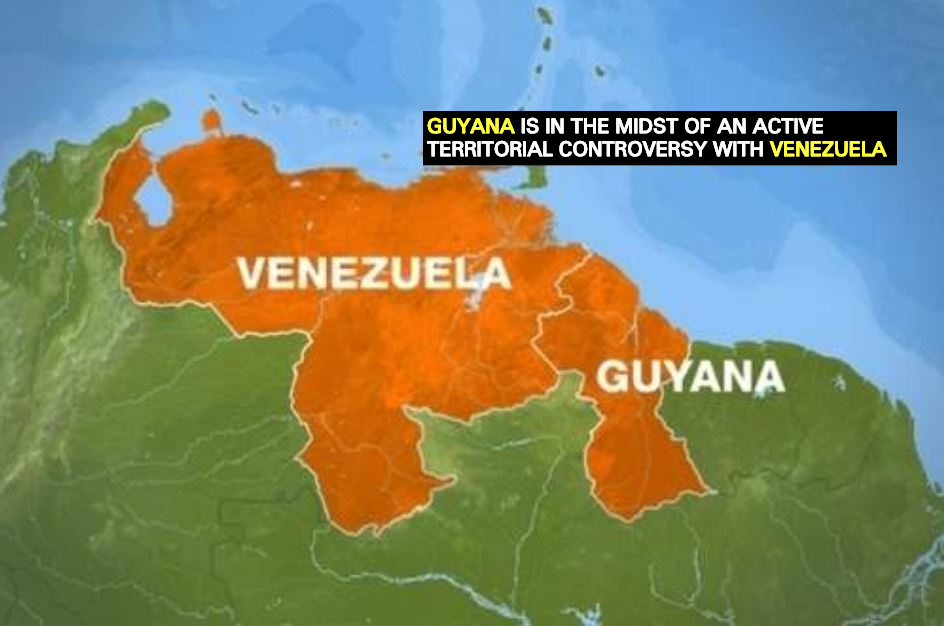
Venezuela explicitly rejected the court’s authority to settle its century-old border dispute with Guyana at the International Court of Justice (ICJ) today. The move came as Caracas delivered a rebuke of Guyana’s legal strategy, warning that any ruling affirming the 1899 Arbitral Award would be a “judicial whitewashing” of colonial aggression.
Despite the ICJ’s prior rulings affirming its right to hear the case, Venezuela’s representative, Samuel Reinaldo Moncada Acosta, told the world court on Wednesday that Caracas considers the court’s authority “erroneously imposed.”
Venezuela maintains that the 1966 Geneva Agreement, not a judicial decree, is the only valid framework for a resolution. Caracas argues that the court lacks the mandate to provide the “mutually satisfactory solution” required by that treaty, instead insisting on direct bilateral negotiations. The crux of Venezuela’s oral arguments was anchored by a powerful statement from Professor Antonio Ramiro-Brotons. The Venezuelan agent cautioned that if the court simply validates the 19th-century boundary as Guyana requested, it would render the modern 1966 treaty meaningless.
“If the court wishes to dismiss this case by declaring that the validity of 1899 Arbitral Award leads to the confirmation of the boundary set out therein, and this is what Guyana wishes, it will reduce the Geneva Agreement to a mere empty shell and will constitute, 127 years later, the final link in the judicial whitewashing of a territorial disposition suffered by Venezuela at the hands of the British Empire,” Ramiro-Brotons stated.
He further warned that a binary judicial decision would fail to resolve the core issue: “And this will not put an end to the controversy. On the contrary, it may exacerbate it by driving the parties further apart. It will merely be another step in a never-ending saga that the parties alone can end through a common agreement. No one should have any interest in fuelling the conflict.”
International law professor Andreas Zimmermann supported this stance by arguing that for decades, both nations had effectively moved past the 1899 award in favor of a “practical settlement.”
Zimmermann cited a 1975 meeting between the leaders of both nations where “possible pathways to a practical solution” were outlined. He highlighted a 1976 proposal by the Guyanese Prime Minister to solve the border issue through “economic cooperation” and a 1977 suggestion by the Guyanese Foreign Minister to rectify border lines at Punta Playa.
“Guyana then was ready to find creative solutions and give up de facto control over territory, which the 1899 award had purportedly allocated to British Guyana,” Zimmermann argued. This practice, he claimed, proves the parties shared an understanding that the Geneva Agreement was meant to replace the “discredited” 1899 award.
Professor Makane Moise Mbengue further characterized the 1899 award as an “artifact of British imperialism” and a “wound that the Geneva agreement was designed to heal.”
Venezuela’s legal team argued that any determination on the award’s validity would unilaterally favor one party, violating the 1966 mandate for a “mutually acceptable” result. They contend that Guyana’s current push for a final, binding judicial ruling is an attempt to use the court to “perpetuate colonial injustices.”
As the hearings continue, Guyana remains firm in its position. On Monday, its legal team dismantled Venezuela’s jurisdictional objections, describing the 1899 award as legally valid, binding, and essential to Guyana’s existential security.