






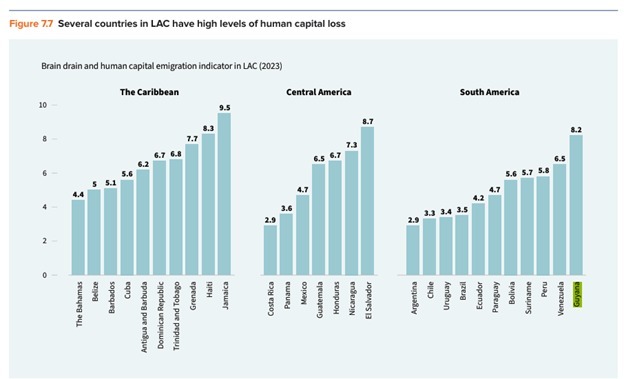
The paradox of Guyana’s current trajectory lies in the disconnect between its soaring GDP and the rapid emptying of its intellectual core. According to the 2026 UNDP “Democracy and Development Report,” the country has recorded a human flight index of 8.2 out of 10, a figure that places it among the top twelve nations globally for brain drain. This exodus is particularly striking because it is occurring within a period of relative state stability and economic expansion. Unlike nations where citizens flee from active warfare or systemic violence, Guyana’s departure is a silent one, driven by a middle class and a professional elite who are utilizing their credentials to seek a higher quality of life in the Global North.
The data reveals a regional disparity, showing that Guyana now leads South America in human capital loss, significantly outpacing neighbors like Venezuela and Suriname.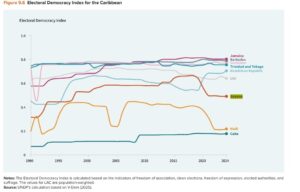
In the Caribbean context, only Jamaica and Haiti, the latter of which is experiencing a total state collapse, rank alongside Guyana. This suggests that the “pull” factors of the international labour market, combined with domestic “push” factors such as stagnating social infrastructure, are creating a vacuum.
Nearly 90 percent of Guyanese with tertiary education eventually relocate, effectively hollowing out the very institutions required to manage the nation’s newfound resource wealth.
A critical driver of this movement is the failure to translate oil revenues into essential social protections, most notably in healthcare. Current data shows that Guyana and Haiti share the lowest life expectancy ratings in the Caribbean, falling well below the regional average. This health gap acts as a primary motivator for nurses, doctors, and educators who feel that the domestic environment lacks the resources necessary for professional growth or personal security. The decision to leave is characterized by the UNDP not as a flight from chaos, but as a rational response to a fragile social infrastructure that has yet to modernize at the same pace as the economy.
This migration pattern has created a “revolving door” demographic tension. While the country’s most skilled professionals depart for North America and Europe, Guyana has simultaneously become a primary destination for those fleeing humanitarian crises elsewhere in the region. However, the report warns that the country is struggling to integrate these new, vulnerable populations into a system that is already failing its own citizens. This cycle weakens public oversight and administrative expertise, leading to what the UNDP describes as a “democratic malaise.”
The setbacks in institutional and electoral quality recorded between 2022 and 2024 suggest that the brain drain is both a symptom of and a contributor to a deeper systemic crisis.
Without a radical shift in policy that prioritizes the retention of human capital over mere profit margins, Guyana risks building a high-growth economy that lacks the human architecture necessary to support a functioning, long-term democracy.





This should not come as a surprise.
Qualified people – and I am referring particularly to East Indians – have faced systematic discrimination for decades under the PNC. We have endured rapes, robberies, murders, genocide, etc., so which foolish East Indian will not want to leave Guyana?
Despite the boom, the sub-species do not want to work but to rob others of hard-earned dollars. It is their chosen way of life. They were captured in the tribal wars in africa and were losers.
I can actually bring and invest $US1M but will I be safe? Naa. And that is why Indians are still fleeing.
What is the point of having money and still have to live like caged animals – grill-work on the windows and doors, employing security guards, having security systems, etc.?