






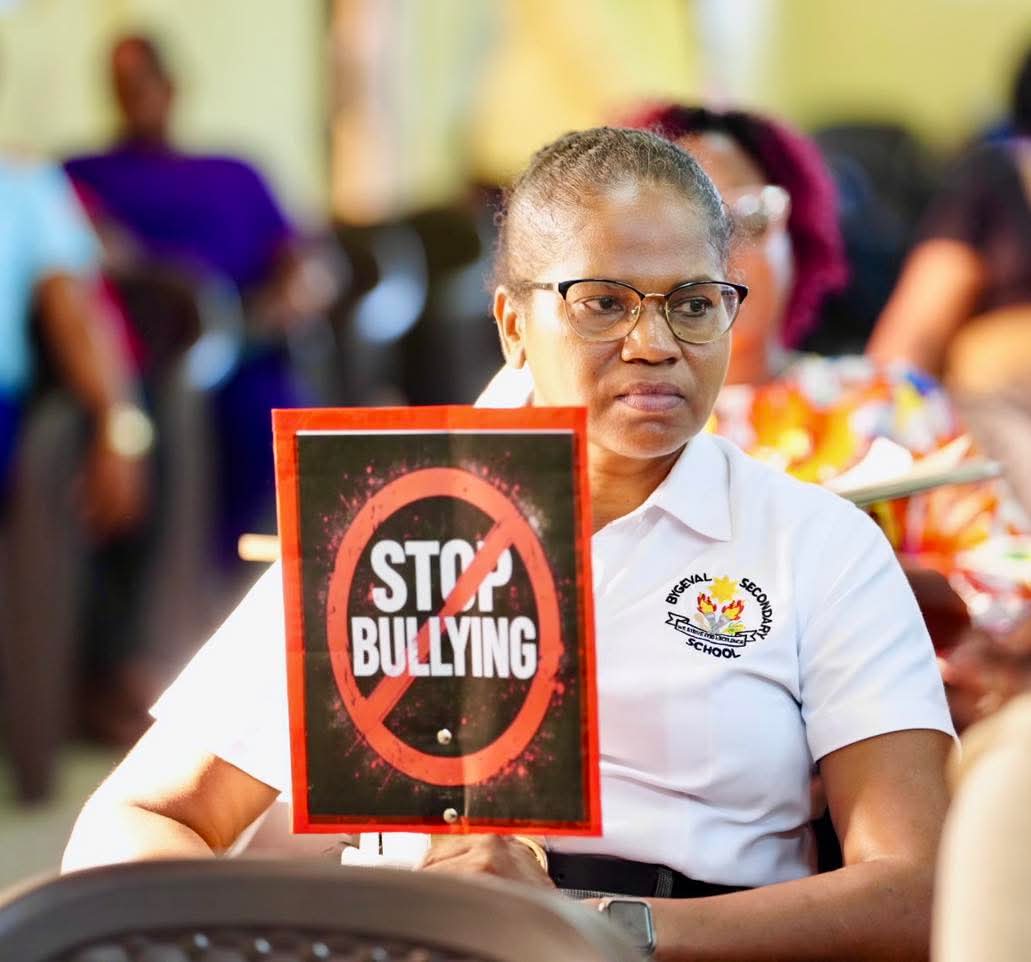
The Ministry of Education has received more than 1,000 recommendations to shape a new nationwide Anti-Bullying and Anti-Violence Policy for schools, with key proposals calling for the establishment of anti-bullying clubs, the nurturing of peer advocates, increased and improved counselling services and stricter punishments like community service or withholding school cash grants for chronic offenders.
Via a press release, the Ministry said that during the final consultation, hosted at the Mahaicony Technical and Vocational Training Centre in Region Five (Mahaica-Berbice) on June 9, some parents also suggested community-led after-school programmes to build camaraderie and good sportsmanship.
Minister of Education, Sonia Parag assured that all recommendations received throughout the campaign will be compiled and thoroughly reviewed by a multi-agency task force, including the Ministries of Home Affairs and Human Services and Social Security. The most substantial and impactful suggestions will then be used to craft a comprehensive policy with clear, standardized consequences for bad and violent behaviors by children and teachers in the school system.
She noted that the policy will cover all forms of bullying and violence. “What we’re seeing is not simply an act of bullying, but it’s also translating into violence and it’s making our spaces that should be safe, unsafe for our children,” Minister Parag said, noting that bullying, even without violence, takes many forms, including social exclusion and verbal attacks. “…It is abuse, psychologically, that can be damaging to that individual.”

The education minister noted too that the policy will also take into crucial account, the manner in which bad behaviours have evolved in this digital age where children can be easily influenced in online spaces that remain readily accessible to them, and largely without proper parental supervision.
“Years ago, a child would be influenced by what happens in their homes, schools and neighbourhoods, but now, they are also influenced by social media and what happens online and the trends that dominate that space,” Minister Parag argued.
Outside of a robust and all-encompassing Anti-Bullying and Anti-Violence Policy for Schools, the Ministry of Education is also pursuing enhanced training for school guidance counsellors beginning this September.
“This will focus heavily on psychology, and help our counsellors to provide more wholesome psychological support, because now we’re dealing with mental health issues that our children are having from these issues, and the realities of suicide and so on.”
Minister Parag said that efforts have also begun to ensure greater supervision within schools and the prompt and timely reporting of incidents to the ministry. The minister is also hopeful that positive changes would stem from the introduction of programmes such as the presidential Prison Avoidance Programme, which aims to teach young people “how to be constructive to society.”
Ultimately though, Minister Parag emphasised that addressing school violence and bullying require an inclusive effort rather than a “one-man show.” She reminded educators that for the eight hours a child is at school, “you are their guardians.”
The education minister was also prompt in declaring that parents have the foundational responsibility of teaching their children good manners and behaviours even before they enter the school system. Parents, Minister Parag said, “cannot pass the buck to schools.”
She spoke extensively on the need for parents and families to look inward at how they manage discipline at home, reasoning that no child is “born bad” and that they instead “sponge up and adopt the behavioural patterns they see at home.”
The minister even gave a candid reality check to parents who often hand over unmonitored devices such as cell phones and tablets to their children. “We are disintegrating into a non-society if we don’t check ourselves,” Minister Parag warned.
She cautioned, however, that “Discipline and abuse are two different things… You absolutely do not need to beat someone to make them understand.”
Regional Education Officer Ms. Selestine La Rose, who spoke briefly at the forum, expressed great satisfaction with the high turnout, noting that the presence of so many key stakeholders highlighted the community’s shared commitment to making schools throughout the country safer.
The final consultation concluded with a frank interactive session, which allowed teachers, students and interested residents across Region Five, the opportunity to voice their concerns.
Minister Parag is hopeful that once the Anti-Bullying and Anti-Violence Policy is fully implemented, the push can begin for corresponding legislation.