






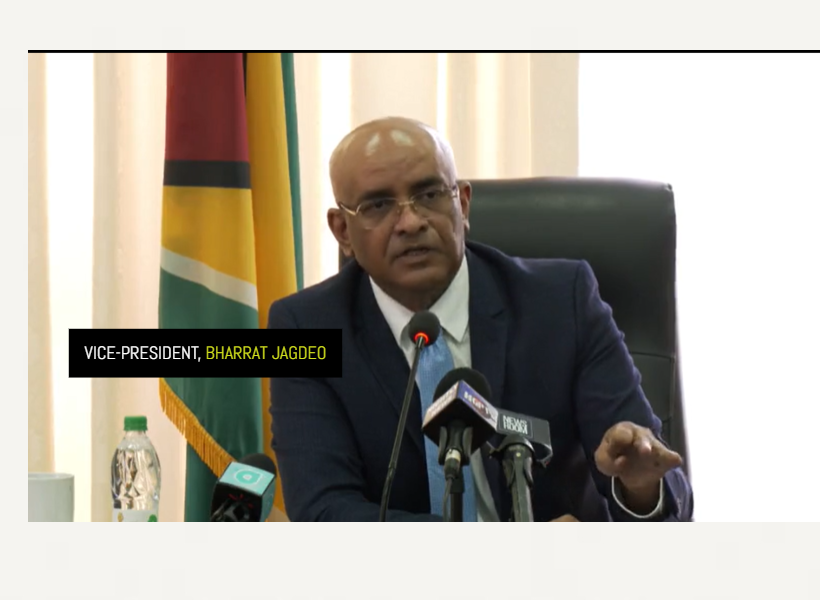
Vice President, Dr. Bharrat Jagdeo on Thursday criticised ExxonMobil Guyana Limited (EMGL) for misleading the public about the taxes Guyana collects from its oil operations and the extent to which those revenues are supporting national budgets.
During an engagement with members of the press, Jagdeo revealed that he had reviewed a document circulated by ExxonMobil at their press briefing held earlier in the day and identified several pieces of misleading information.
“Now I look through this and obviously Exxon is trying to defend its position and its investment in Guyana and they are free to do that…” Jagdeo said.
However, he noted, “But what I’ve seen here is that somehow Exxon wants to speak about the revenue…now what Exxon is trying to do, they [not only] want to take credit for the substantial investment and production, but also take credit for our tax revenue.”
He highlighted that while cooperate tax is a normal part of conducting business in a country – Exxon enjoys a tax-free ride in Guyana for its Stabroek Block operations. Jagdeo reminded that this is as a result of the Production Sharing Agreement (PSA) that was signed in 2016 by the previous administration with Exxon. It should be noted that the oil deal provides for taxes owed by the company to be paid by Guyana.
Also, Jagdeo stated that the lopsided deal gives Guyana way less than a fair share from the revenues generated from the oil operations.
He told reporters that Exxon’s financial document is creating the impression that the massive 2024 national budget is fully financed from the company’s tax payments. Jagdeo said, “So they [Exxon] want to speak about the national budget and they have shown the growth in the national budget from 2020 to now, and somehow is attributing this to their tax revenue.”
“Now, this is very misleading,” Jagdeo said. He added, “What Exxon should focus on is how much money they are making, that’s what they should tell the reporters, not how much taxes we are collecting.”
Jagdeo reiterated that although the 2024 budget amounts to $1.1 trillion, less than 30% of this total is sourced from the oil and gas sector. He highlighted that over $400 billion of the budget is financed by non-oil revenues, with approximately $300 billion contributed by the oil and gas sector.
As such, he urged Exxon’s public relations department to avoid creating false impressions and shared that he even contacted the company and warned them about this.
The Vice President outlined that the money from the oil and gas sector used in the budget, is mainly attributed to revenues from the profit sharing agreement in accordance with the 2016 deal, and not from taxes.
According to the agreement, Guyana receives a 2% royalty on oil revenues. Additionally, 75% of the revenues generated from oil operations are retained by Exxon to cover expenses, with the remaining being split 50-50 between Guyana and the oil companies.
“We all agree that if we had a better PSA, the profit share should have been higher in the initial stage,” Jagdeo noted.