



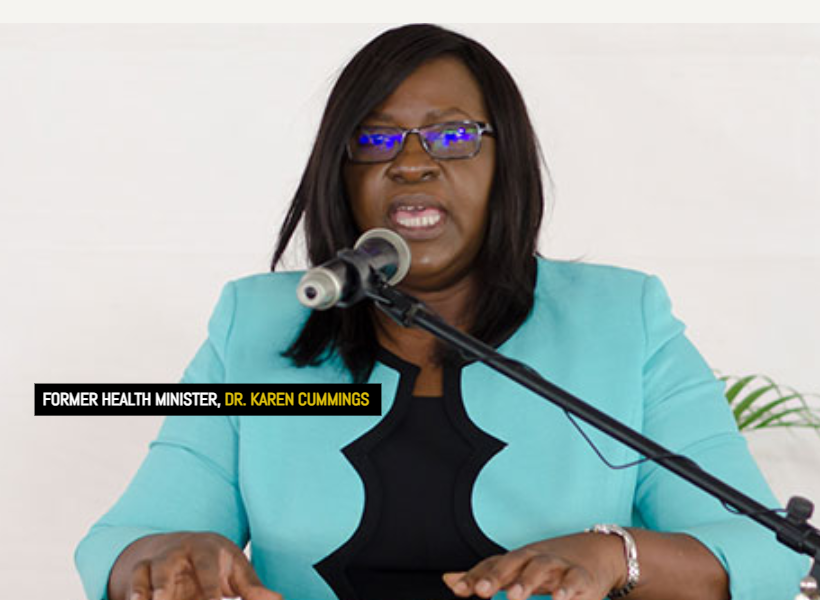
Former APNU Member of Parliament and former Minister of Health Dr. Karen Cummings has called on the Government to ensure that Guyana’s growing economic resources can translate to improvements in healthcare, life expectancy and the overall well-being of citizens.
In a statement marking Breast Cancer Awareness Month, Cummings said the observance should encourage greater attention to early detection, treatment and survival, while also prompting wider questions about the state of healthcare in Guyana.
She pointed to Guyana’s overall life expectancy and compared it with Barbados, arguing that the country’s rapidly expanding economy has not yet produced comparable improvements in longevity.
“A Guyanese can expect to live approximately 70 years. In Barbados it is approximately 76 years.” She added, “Guyana’s GDP per capita has moved above Barbados, yet a Barbadian can expect to live approximately six years longer.”
Cummings said this disparity raises a broader question about whether Guyana’s economic transformation is being reflected in improvements in the lives of its citizens.
“Hence, the issue that is being raised here is the life expectancy of our citizens. Our economy has been transformed much faster than some of the basic indicators of the lives of our people.”
Turning specifically to breast cancer, Cummings argued that Breast Cancer Awareness Month must extend beyond symbolic activities and encourage greater scrutiny of the entire system of detection, diagnosis, treatment and survival.
“The numbers have indicated that Breast Cancer Awareness Month cannot only be about wearing pink and telling women to examine themselves. We must look at the entire system from detection to diagnosis, treatment, and survival.”
She said greater attention should be paid to how many eligible women are being screened, the stages at which breast cancer is being diagnosed, how long women wait for confirmation following an abnormal finding and the time between diagnosis and the commencement of treatment.
Cummings also turned her attention to public expenditure on healthcare, noting the size of the health allocation in the 2026 National Budget.
“The budget also deserves examination. The 2026 national budget is approximately G$1.558 trillion, of which G$161.1 billion is allocated to health. This is approximately 10.3% of the national budget and a significant amount of money.”
While acknowledging investments in the sector, Cummings questioned whether that expenditure was producing sufficient improvements in health outcomes for Guyanese.
“We welcome investment in health infrastructure, example, hospitals, equipment, medicines, and healthcare workers. But we also must ask: What outcomes are we getting from the money? Are we getting value for money? These investments are inadequate and are not improving the lives of Guyanese.”
Cummings further drew comparisons between Guyana and other Caribbean countries in relation to current health expenditure as a percentage of gross domestic product.
“International comparisons are useful here. WHO data show that Guyana’s current health expenditure is approximately 4.9% of GDP, compared with approximately 5.7% in Suriname, 7.2% in Jamaica and 8.1% in Barbados.”
She called for the establishment of a Guyana Human Development Scorecard, which she said should be published annually and provide information on breast cancer survival and other development indicators, including comparisons with the Caribbean and wider world.
For breast cancer specifically, Cummings called for clear targets covering cancer communication, screening, early diagnosis, waiting times for treatment and survival. She also called for adequate diagnostic capacity, pathology services, cancer specialists, surgery, radiotherapy and access to medicines required for modern cancer treatment.