



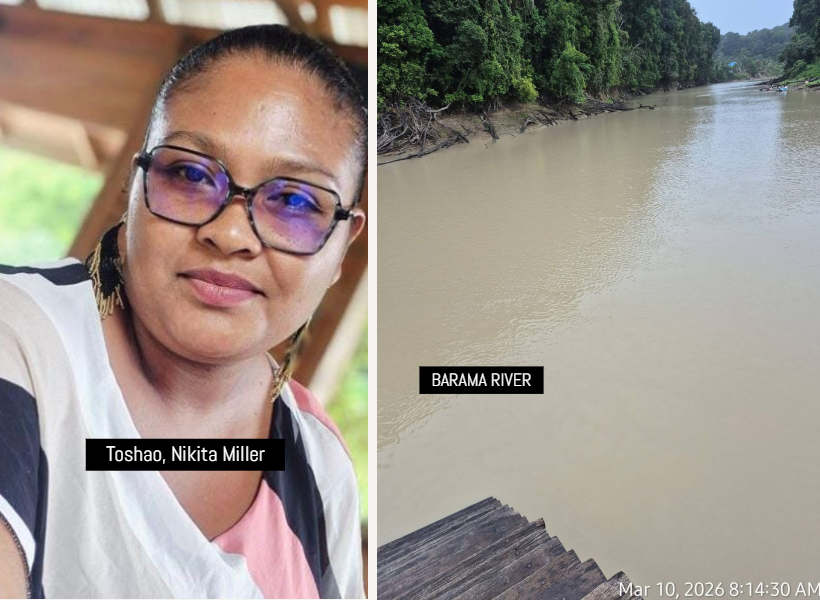
For the residents of Chinese Landing, the Barama River is not just a body of water, it is their source for washing and bathing as well as their most relied on fishing area. But today, that lifeline has turned almost useless to them. The body of fresh water is now contaminated by a thick whitish substance. Guyana Standard understands this to be the result of a single mining “dragger ” (dredge) that villagers say is operating with impunity, despite repeated health warnings.
The crisis highlights a disconnect between resource extraction and the fundamental right to clean water in Guyana’s hinterland.
On paper, Chinese Landing has seen progress with the installation of a community well. However, Toshao Nikita Miller told Guyana Standard that infrastructure “on paper” does not translate to water in the homes of her people. Of the 50 households in the village, Miller said only 10 currently receive direct water from the well. While a project is underway to connect an additional eight homes, the reality is that 32 families, and the majority of the 250 residents, remain entirely dependent on the river.
“The government buildings are receiving direct water from the well, but the rest of the households are out of clear water,” Miller explained. “We are grateful for the well, but you cannot swim, wash clothing, or fish in a well, ” Miller said.
The history of this specific dredge reads like a game of cat-and-mouse. After being reported in late 2024, the operators were forced to leave in early 2025 because they lacked documentation. By March 16, 2025, the dredge returned, reportedly with its paperwork in order, and resumed operations in the exact spot.
For the villagers, the “legal” status of the dredge matters little when the physical result is the same: high turbidity and a surge in illness. During a Regional Toshao Conference in May 2025, medical teams confirmed that an outbreak of diarrhea and vomiting in the village was likely linked to the water’s condition.
“The doctor said the turbidity is very high,” Miller said. “And that was it. We haven’t heard back anything from the Ministry of Natural Resources. Everything is back to normal for them, but not for us.”
The situation has reached a breaking point during the current dry season. As local creeks dry up, they flow into the Barama, concentrating the pollutants. What used to be a clear river has become an “overbearing” milky stream.
Beyond the physical sickness, a sense of “reporting fatigue” is settling over the village leadership. Toshao Miller admitted to sometimes staying “numb” to the situation because her repeated pleas to the government seem to fall on deaf ears.
“I don’t want to be a target to no one,” Miller said, noting the personal risk of speaking out against mining interests. “But it really irritates me to see these things happen and there is nothing being done. It’s like we’ve been singled out.”
As the water levels continue to drop, the residents of Chinese Landing are left watching a river they can no longer use, waiting for a response from authorities and still hoping for intervention. But that hope is now as murky as the Barama itself.