





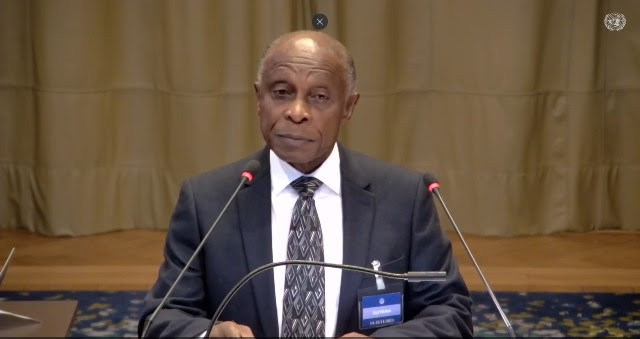
Former Guyanese Foreign Minister, Carl Greenidge in his remarks before the International Court of Justice (ICJ) today, said that it was Venezuela, not Great Britain, that pushed for the arbitration process that settled the border between it and Guyana.
“The history is clear and established by the evidence before the court…It was Venezuela that insisted on arbitration,” Greenidge said. He added that Venezuela’s push for arbitration in 1883 had come after years of unsuccessful negotiations with Britian.
At the time, he noted, Venezuela sought a binding decision from an arbitrator jointly selected by both parties.
Greenidge remined that Britain had denied the proposal in its initial form, particularly over disagreements regarding the scope of the territory to be included in the arbitration.
Faced with this setback, Venezuela escalated its efforts, severing diplomatic relations with Britain in 1887 and seeking external support to advance its position.
According to Greenidge, it was at this stage that Venezuela turned to the United States of America for assistance.
“It was Venezuela that brought the United States into the picture to help it obtain the arbitration agreement with Great Britain that it was unable to obtain on its own,” he told the court.
Greenidge said Venezuela urged the United States to use its influence to compel Britain to agree to arbitration covering the entire territory between the Essequibo and Orinoco Rivers.
Those efforts eventually succeeded, culminating in the signing of the 1897 Treaty of Washington, which formalised the agreement to submit the controversy to arbitration.
“And, ultimately… Venezuela secured the arbitration agreement on which it had been insisting for more than a decade,” he said.
He added that Venezuela not only supported the treaty at the time but also celebrated it as a major diplomatic achievement.
“Venezuela heralded and celebrated the treaty as the accomplishment of its long-sought objective,” he noted.
He further pointed out that Venezuela maintained this position for decades, neither questioning nor criticising the treaty or its implementation. “It neither questioned, challenged, nor criticised the treaty,” he said, referring to the period following the arbitration.
In contrast, he told the court, Venezuela’s current arguments represent a complete reversal of its earlier stance. “In these proceedings, Venezuela takes exactly the opposite position,” Greenidge said, noting that the country is now attempting to discredit the very agreement it once championed.