





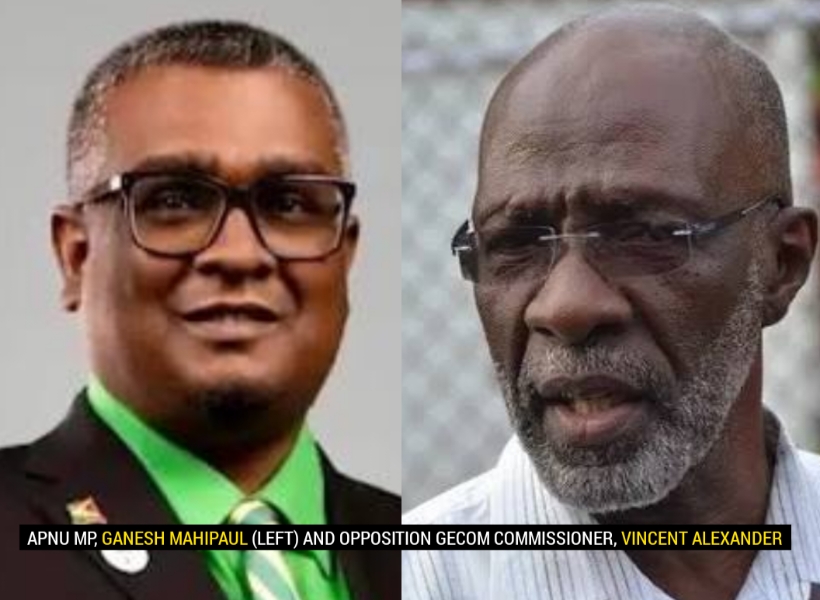
A Partnership for National Unity (APNU) Member of Parliament, Ganesh Mahipaul is paying keen attention to what he terms the “creeping control” and systematic undermining of Guyana’s constitutional agencies and statutory bodies by the Executive arm of government.
During an interview with Guyana Standard, Mahipaul warned that while many local institutions are constitutionally mandated to operate independently and free from political interference, practical developments suggest they are increasingly being brought under government influence.
Central to Mahipaul’s argument is the current process governing budgetary allocations for independent bodies. According to the Member of Parliament, several constitutional agencies are now required to vet their financial proposals with a government minister before the estimates are presented to the legislature.
“Several constitutional agencies, after preparing their budgets, are reportedly required to first engage Minister Gail Teixeira before proceeding to the Ministry of Finance to defend their requests,” Mahipaul stated.
He questioned how these entities could maintain true autonomy under such conditions. “How can institutions truly claim independence if their financial survival and operational capacity are subjected to political oversight before reaching the Parliament for approval,” Mahipaul asked.
Echoing Mahipaul’s assertions of executive overreach, is Guyana Elections Commission (GECOM) Commissioner, Vincent Alexander who disclosed to the Guyana Standard that the country’s electoral management body has been functioning without full oversight.
Alexander revealed that GECOM has failed to meet for an extended period, allowing the administrative arm to bypass standard commission protocols, specifically regarding financial planning.
“Well, the fact of the matter, since the 7th of September, GECOM has not met and the administration has been doing some things, some of which they ought not to do without the Chairperson. For example, the submission of budget estimates without the involvement of the commission,” Alexander stated.
The Commissioner warned that the lack of statutory meetings and centralized decision-making has effectively paralyzed the constitutional watchdog’s intended bipartisan structure. “So that, in some regards, it could be considered that the commission is comatose,” Alexander asserted. “But it also, in some regards, has been hijacked by the administration under the aegis of the Chairperson.”
Beyond the electoral commission, Mahipaul highlighted discrepancies in resource distribution and administrative oversight within the Legislature itself. He noted that, for the first time in parliamentary history, MPs are currently operating without state-issued electronic devices to assist with their official duties, contrasting this with the continuous state-funded benefits, including covered telephone expenses, enjoyed by Government Ministers.
Additionally, the opposition MP pointed to systemic delays within parliamentary oversight bodies, revealing that the Parliamentary Management Committee has now been without a substantive head for nearly 100 days with “little urgency to address the issue.”
The opposition maintains that these entities were explicitly designed to serve as safeguards for democracy and to operate in the interest of all Guyanese, rather than functioning as extensions of the Executive.
“A healthy democracy depends on strong and independent institutions,” Mahipaul stressed. “When Governments begin exerting excessive influence over bodies that are supposed to provide oversight, balance and impartiality, democracy itself becomes weakened.”
Warning of the long-term implications of executive overreach, Mahipaul concluded that the concentration of control should concern all citizens. “Independent institutions must not only exist in constitutional language; they must exist in practice,” he stated.