

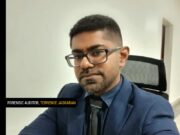




Terrence Jaskaran, today, returned to the witness stand for the fourth day with defence attorney Eusi Anderson challenging his political views and the basis for his conclusions about election rigging during cross-examination in the Georgetown Magistrates’ Court.
Jaskaran, who is giving evidence as an expert witness in the 2020 election fraud case, was questioned by Anderson about a series of Facebook posts in which he expressed support for the People’s Progressive Party/Civic (PPP/C) and criticised the APNU/PNC.
Anderson first confronted Jaskaran with a six-page post dated August 31, 2025, in which he explained why he intended to vote for the PPP/C in that year’s elections.
While Jaskaran resisted describing the post as an “endorsement,” he agreed it contained his publicly expressed views in support of the PPP/C and that it was published before he gave evidence as an independent expert in the case.
Anderson also pressed him on whether those political views had affected his testimony.
After initially giving an answer Anderson described as indirect, Jaskaran eventually stated clearly that his support for the PPP/C had not affected his testimony.
The defence then turned to a June 2023 post in which Jaskaran referred to APNU staff as “inept” and used the term “witchcraft” when discussing the party’s election calculations.
Jaskaran maintained that those were his personal views as a citizen and disputed Anderson’s characterisation of the comments, saying the reference to “witchcraft” related to a mathematical formula rather than the APNU’s staff.
He also told the court that he did not believe he was required to disclose his political commentary before giving evidence because his Facebook account was public and the views were expressed in his capacity as a citizen.
Anderson subsequently challenged Jaskaran over an August 2025 article titled “APNU, PNC, and their infamous history of elections rigging,” in which Jaskaran discussed elections dating back to 1968.
The lawyer took Jaskaran through his descriptions of the 1968, 1973, 1980 and 1985 elections, each of which Jaskaran described as having been rigged by the PNC.
Anderson contrasted those descriptions with Jaskaran’s references to the 1992, 1997, 2001 and 2006 elections as free and fair, asking whether the analysis amounted to a conclusion that the PNC rigged elections while the PPP/C did not.
Jaskaran rejected that characterisation, maintaining that his analysis was based on research and quotations from international observers and other sources.
Anderson also questioned the foundation of Jaskaran’s historical conclusions, pointing out that he had not personally seen original election materials for several of the earlier elections he discussed.
Jaskaran said his research included sources such as United States government documents, Human Rights Watch material and Carter Centre publications.
The defence further suggested that Jaskaran’s political views may have influenced the forensic report he prepared in relation to the elections.
Jaskaran rejected that suggestion, saying there was an ethical requirement for him to separate his views as a citizen from his professional work.
“I respectfully disagree,” Jaskaran told the court when Anderson suggested that he believed the PPP/C was the best political party to run Guyana when he prepared his report and when he came to testify.
Jaskaran maintained that his professional conclusions were separate from his personal political views.