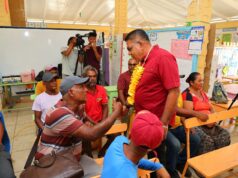







See full statement below from the Working People’s Alliance (WPA) which paid tribute to longstanding member, Eusi Kwayana on his 100th birth anniversary:
WPA joins with the rest of Guyana, Buxton, the Caribbean, the Pan African world and progressives the world over in saluting Brother Eusi Kwayana on his 100th birth anniversary today April 4. It is difficult to capture Bro Eusi’s contributions to his village, country and region in a press release, so we will not attempt to do so.
But suffice to say that the Sage of Buxton, as he is fondly known, is a living testimony to the promise of a humane Guyana. He is one of the finest products of our country—a selfless crusader for justice and dignity in every aspect of our collective national journey. His eight decades of political and social activism have allowed him to experience and influence the twists and turns of our socio-political, economic and cultural decolonization and post-colonization.
While we have not produced saints in public life, Kwayana comes closest to that designation. Incorruptible even as corruption became a staple in politics, he is a persistent example that human beings are by nature moral beings destined to live in a state of freedom. A political activist by conviction, his politics have been buttressed by education, drama, folklore, journalism and scholarship. Bro Eusi constantly reminds us of what it is to be human.
Our party owes a lot to Kwayana’s activism, wisdom and leadership. But he transcends parties or a party. He is Guyana’s unique gift to itself and the world. WPA views his longevity as a special blessing from God and the ancestors. We thank him for his contributions. We thank his family for sharing him with us. We look forward to his continued guidance and blessings. We love you, Bro Esui.
Kwayana{ A short biography
Eusi Kwayana, formerly Sydney King, was born in 1925 and has been involved in Guyana’s national politics since 1947.He has been referred to as the “Sage of Buxton,” Renaissance Man” and “Guyana’s Gandhi,” among other descriptions. His public life is multi-faceted– political activist, educator, writer, journalist, dramatist, folklorist, and historian. But it is as a political activist that Kwayana has made his most telling contribution and is best known to Guyanese. He has become one of Guyana’s most distinguished political leaders.
He entered the political arena as a supporter of Cheddi Jagan in his successful bid for a seat in the Legislative Council in 1947. He soon joined the Political Affairs Committee (PAC), a small left-wing group that was the precursor to the People’s Progressive Party (PPP), the country’s first mass-based political party. He served as Assistant General Secretary of the PPP, Kwayana, who easily won his parliamentary seat, became Minister of Works in the new government which lasted for 133 days.
When, in 1955, the PPP split generally along ethnic lines, Kwayana was one of a group of Africans that remained with the Cheddi Jagan faction. However, he left the Jagan faction in 1956 largely over the party’s refusal to take Guyana into the West Indies Federation. After unsuccessfully running as an independent candidate at the 1957 election he joined the newly- formed People’s National Congress (PNC) led by Forbes Burnham and served as General Secretary and editor of the party’s organ, New Nation until he was expelled from the party in 1961 for publicly engaging the ethnic problem.
He co-founded in 1961 the African Society for Racial Equality (ASRE), which was dedicated primarily to raising cultural consciousness among African Guyanese and championing the cause of ethnic equality open ethnic conflict that lasted from 1961 to 1964. Amidst the ethnic violence that engulfed the country, Kwayana, in 1964, co-founded the African Society for Cultural Relations with Independent Africa (ASCRIA), which, like ASRE, committed itself to the promotion of African pride, dignity, and culture among African Guyanese. He served as Coordinating Elder of ASCRIA and changed his name to Eusi Kwayana, which, in Swahili, means “Black Man of Guyana.”
Although he never rejoined the PNC he supported the party, which rose to power in 1964 as part of a coalition with the United Force (UF).He held several influential positions in the government— head of the National Land Settlement Committee; chairman of the Guyana Marketing Corporation (GMC); chairman of the Cooperative Insurance Committee; and chairman of a committee charged with converting the Guyana Cooperative Credit Society into a Cooperative Bank. He was also instrumental in developing the country’s foreign policy towards Africa. In addition, it was he, Kwayana who suggested to Burnham that our republic be named the “Cooperative Republic of Guyana.”
In 1971 he broke with the PNC over the issue of government corruption and became one of its severest critics. In the process Kwayana and ASCRIA began to develop relations with other radical anti-government organizations such as Moses Bhagwan’s Indian People’s Revolutionary Associates (IPRA and Clive Thomas’ RATOON which in 1974 merged to form the Working People’s Alliance (WPA). He has been a 1eading member of the party and was its presidential candidate in 1985 and parliamentarian in the years 1986-90
Kwayana has a long trail of writings, beginning with his writings in the PPP’s Thunder in the early 1950s during which time he wrote many articles and editorials that did not carry his byline. He would later serve as editor of the PNC’s New Nation, ASCRIA’s ASCRIA Drums and WPA’s Dayclean and Open Word. In addition to his journalistic writings, Kwayana has written many books, academic papers and policy papers. Most of his writings have addressed the concrete issues of the particular time, but others have addressed broad issues such as race and ethnicity, governance, and culture. He has also written the party songs of the PPP, PNC and WPA.
His books include Next Witness. Guyana: No guilty Race ; Buxton-Friendship in Print and Memory, Scars of Bondage (co-authored with his wife, Tchiko Kwayana),; The Morning after; , Walter Rodney: His last days and campaign; The Bauxite Strike and the Old Politics; Jonestown; Dimensions from a Guyanese Perspective; The Legend: Post Emancipation Villages in Guyana’ Gang Gang: Thirty five Guyanese Proverbs.