




By Abena Rockcliffe
Even as Guyana embraces its role as leader in CARICOM on agriculture and food security, the country is partnering with global leaders to join in its quest to further upgrade. In this regard, the principals on agriculture in Guyana and Brazil are speaking the same language; no time can be wasted in moving Guyana to the next level of agricultural productivity.
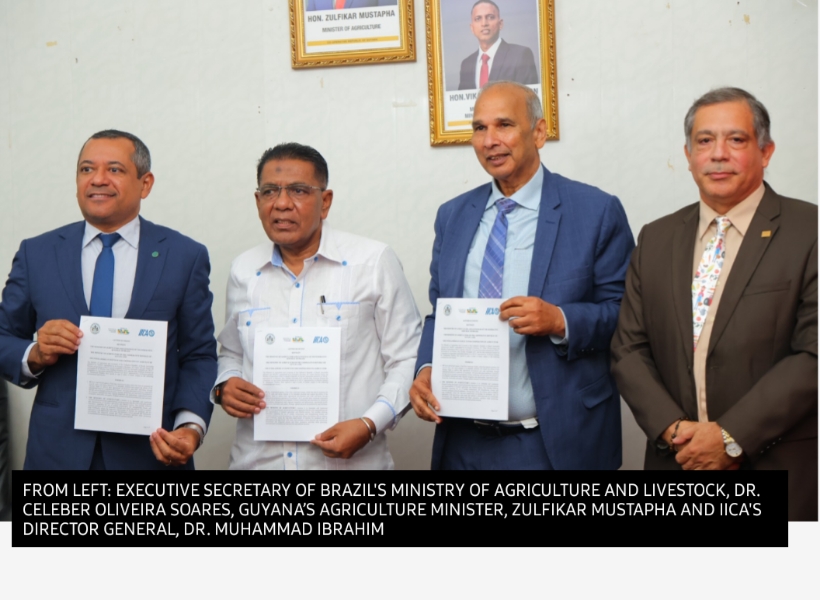
This morning, Executive Secretary of Brazil’s Ministry of Agriculture and Livestock, Cleber Oliveira Soares said it is time to “drive fast” to transform CARICOM and Central America.
While, Guyana’s Minister of Agriculture, Zulfikar Mustapha affirmed that the time for incremental change has passed.
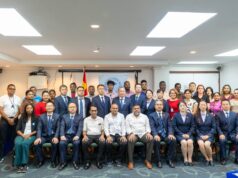
The leaders made these pronouncements at the launch of EMBRAPA’s Science, Technologies and Innovation Hub in Guyana.
EMBRAPA is the Brazilian Agricultural Research Corporation headquartered in Brasilia. It operates over 40 decentralized research centers and focuses on tropical agriculture, sustainability and technological innovation to ensure food security.
The launch ceremony was hosted at Ministry of Agriculture’s head office where the “Letter of Intent” was signed. At that forum, the media was told of the role the Inter-American Institute for Cooperation on Agriculture (IICA) played in having the hub in Guyana instead of Costa Rica, where IICA is headquartered. Truly, the hub is a collaboration amongst Guyana, Brazil and IICA.
Brazil’s Soares spoke about how his country was able to move from being heavily dependent on food import some 50 years ago to now being largely self-sufficient while being able to export 25 percent of its produce. He said that the strides made are directly tied to investments in science technology and innovation. Brazil is now in a position to provide a blue print on food security even in the face of global challenges including climate change.
IICA’s Director General, Dr. Muhammed Ibrahim noted that his initiative is a key force to achieve Caricom’s ambitious 25% by 2025+5 initiative.
He noted EMBRAPA’s expertise in the advancement of modern agriculture. Dr. Ibrahim revealed that he is in the process of formulating a new medium-term plan for agricultural development in the region and the new hub will be pivotal to the successful implementation of that plan.
Mustapha, who delivered the featured address, said the initiative is testament to shared commitment to advancing agricultural innovation, strengthening scientific cooperation, and building a more resilient and food‑secure Caribbean.
He said that challenges like climate volatility, supply‑chain disruptions, and rising global food prices demand solutions that are science‑driven, data‑driven, and regionally coordinated. He said those solutions must be provided almost immediately as “The time for incremental change has passed.”
Mustapha noted that Guyana’s private sector will be a key beneficiary of the technologies and expertise passed on via this initiative.
He noted that the hub will facilitate joint research and technology deployment, consolidate Guyana’s role as a regional platform for agricultural innovation, and strengthen regional capacities to address trans-boundary pests, diseases, and systemic risks.
Further, Mustapha said, “the Hub will ensure that our farmers have access to the technologies, knowledge, and innovations they need to thrive in a changing climate. And it will enable us to build regional scientific capacity so that Caribbean countries can generate, adapt, and scale solutions suited to our own tropical realities. Together, we are laying the foundation for a new era of Caribbean agriculture, one that is innovative, climate‑resilient, competitive, and globally connected. This Hub is not just a project; it is a commitment to future generations.”
The Minister told the media his counterparts are confident that the necessary steps can be made to get the hub up and running within six months. He said that, on the side of caution, he has committed to year’s time. With that stated, Mustapha declared that agriculture in Guyana will be top tier within another two years.